07 July 2009

it's that time again

[click image]

There were two Mick Hucknell songs I always loved. This one is a masterpiece, but it's not the one of the two he sang that knocked me out. There was another one. Even more sublime singing. It drove me nuts that his voice had to be wasted on disco and that there wasn't someone at least as good as Bernie Taupin to keep him in great songs, but I cannot goddam remember the other song! It was transcendental! It didn't get the airplay this one did, but it would unerringly leave me in a puddle of admiration for those pipes, and, so, well, you'd think I could have kept a bead on that, now wouldn't you?

Every couple of years I try to endure all the duds to find it and always fail.

[Turns out he just sang it in Budapest a week ago or so...]

---------------------------------------

That darn Joely came up with a brilliant suggestion and so I spent a lot more time trying to dig it up, until my connection dropped in the middle of the night, and I'm just going to have to save it for my next urge. But, basically, Simply Red's first album does not suck in spots, and you could do worse than to go listen to the cut "Picture Book" on the album of the same name.

dragg will go batshit crazy over this image

[click image]

Whereas, I'm going batshit crazy over what it links.

Question is: ARE you getting the picture?

norman

[click image, h/t Ann El Khoury]

which?

[click image]

this fascism has very far-reaching implications

[click image]

who is in charge at main justice?

[click image]

This is terrifying.

shifting the political price for fascist activities

[click image]

Obama, from Moscow, supposedly putting out that fire: I am pleased by the progress we're making on health care reform and still believe, as I've said before, that one of the best ways to bring down costs, provide more choices, and assure quality is a public option that will force the insurance companies to compete and keep them honest. I look forward to a final product that achieves these very important goals.

Noticing a pattern, here, yet? Just in the last few days: Honduras, Israel attacking Iran, Healthcare....

And, now that Democrats have the super-majority in both houses, it's those darn "centrist Democrats" who will be blamed instead of the Republicans.

helping the honduran coup succeed

[click image]
Even as we meet here today, America supports now the restoration of the democratically-elected President of Honduras, even though he has strongly opposed American policies. We do so not because we agree with him. We do so because we respect the universal principle that people should choose their own leaders, whether they are leaders we agree with or not. --Barack Obama, 7 July 2009, Moscow

----------------------------------------------------
UPDATE: I just don't like it, not one little bit.
Clinton said Zelaya and the interim government should commit themselves to reaching a deal in talks with Arias, who won the Nobel peace prize in 1987 for helping to end political violence in El Salvador.

"I believe [dialogue] is a better route for [Zelaya] to follow at this time than to attempt to return in the face of the implacable opposition of the de facto regime," she said.

Mariana Sanchez, Al Jazeera's correspondent in Tegucigalpa, said on Tuesday: "There is a lot of speculation as to what will now happen here.

"The military-backed interim government yesterday sent a delegation to Washington made up of former presidents and former ministers ... [who] are going to meet some [US] Republican senators. This is going parallel to the announcement that Clinton made.

"The supreme court judge of Honduras ... said the interim government has allowed the court to name a commission that would help bring the country to a national dialogue and even offer amnesty to Zelaya of charges that he is facing in the country."
It's so creepy. Clinton could call Tegucigalpa and that would be the end of it, and she's gotten them to offer him amnesty for bogus charges instead?

'make no mistake' and 'let me be clear', punctuated by crap

[click image, C-SPAN video, 31 minutes]
Text: Obama’s Speech at the New Economic School
Published: July 7, 2009

Following is a text of President Obama's remarks delivered at the New Economic School in Moscow, as released by the White House.

THE PRESIDENT: Thank you so much. Well, congratulations, Oxana. And to the entire Class of 2009, congratulations to you. I don't know if anybody else will meet their future wife or husband in class like I did, but I'm sure that you're all going to have wonderful careers.

I want to acknowledge a few people who are here. We have President Mikhail Gorbachev is here today, and I want everybody to give him a big round of applause. (Applause.) I want to thank Sergei Gurief, Director of the New Economic School. (Applause.) Max Boiko, their Chairman of the Board. (Applause.) And Arkady Dvorkovich, who is the NES board member, President of the Alumni Association and is doing an excellent job for President Medvedev, because he was in our meeting yesterday. (Applause.)

Good morning. It is a great honor for me to join you at the New Economic School. Michelle and I are so pleased to be in Moscow. And as somebody who was born in Hawaii, I'm glad to be here in July instead of January. (Laughter and applause.)

I know that NES is a young school, but I speak to you today with deep respect for Russia's timeless heritage. Russian writers have helped us understand the complexity of the human experience, and recognize eternal truths. Russian painters, composers, and dancers have introduced us to new forms of beauty. Russian scientists have cured disease, sought new frontiers of progress, and helped us go to space.

These are contributions that are not contained by Russia's borders, as vast as those borders are. Indeed, Russia's heritage has touched every corner of the world, and speaks to the humanity that we share. That includes my own country, which has been blessed with Russian immigrants for decades; we've been enriched by Russian culture, and enhanced by Russian cooperation. And as a resident of Washington, D.C., I continue to benefit from the contributions of Russians -- specifically, from Alexander Ovechkin. We're very pleased to have him in Washington, D.C. (Applause.)

Here at NES, you have inherited this great cultural legacy, but your focus on economics is no less fundamental to the future of humanity. As Pushkin said, "Inspiration is needed in geometry just as much as poetry." And today, I want particularly to speak to those of you preparing to graduate. You're poised to be leaders in academia and industry; in finance and government. But before you move forward, it's worth reflecting on what has already taken place during your young lives.

Like President Medvedev and myself, you're not old enough to have witnessed the darkest hours of the Cold War, when hydrogen bombs were tested in the atmosphere, and children drilled in fallout shelters, and we reached the brink of nuclear catastrophe. But you are the last generation born when the world was divided. At that time, the American and Soviet armies were still massed in Europe, trained and ready to fight. The ideological trenches of the last century were roughly in place. Competition in everything from astrophysics to athletics was treated as a zero-sum game. If one person won, then the other person had to lose.

And then, within a few short years, the world as it was ceased to be. Now, make no mistake: This change did not come from any one nation. The Cold War reached a conclusion because of the actions of many nations over many years, and because the people of Russia and Eastern Europe stood up and decided that its end would be peaceful.

With the end of the Cold War, there were extraordinary expectations -- for peace and for prosperity; for new arrangements among nations, and new opportunities for individuals. Like all periods of great change, it was a time of ambitious plans and endless possibilities. But, of course, things don't always work out exactly as planned. Back in 1993, shortly after this school opened, one NES student summed up the difficulty of change when he told a reporter, and I quote him: "The real world is not so rational as on paper." The real world is not so rational as on paper.

Over two tumultuous decades, that truth has been borne out around the world. Great wealth has been created, but it has not eliminated vast pockets of crushing poverty. Poverty exists here, it exists in the United States, and it exists all around the world. More people have gone to the ballot box, but too many governments still fail to protect the rights of their people. Ideological struggles have diminished, but they've been replaced by conflicts over tribe and ethnicity and religion. A human being with a computer can hold the same amount of information stored in the Russian State Library, but that technology can also be used to do great harm.

In a new Russia, the disappearance of old political and economic restrictions after the end of the Soviet Union brought both opportunity and hardship. A few prospered, but many more did not. There were tough times. But the Russian people showed strength and made sacrifices, and you achieved hard-earned progress through a growing economy and greater confidence. And despite painful times, many in Eastern Europe and Russia are much better off today than 20 years ago.

We see that progress here at NES -- a school founded with Western support that is now distinctly Russian; a place of learning and inquiry where the test of an idea is not whether it is Russian or American or European, but whether it works. Above all, we see that progress in all of you -- young people with a young century to shape as you see fit.

Your lifetime coincides with this era of transition. But think about the fundamental questions asked when this school was founded. What kind of future is Russia going to have? What kind of future are Russia and America going to have together? What world order will replace the Cold War? Those questions still don't have clear answers, and so now they must be answered by you -- by your generation in Russia, in America, and around the world. You get to decide. And while I cannot answer those questions for you, I can speak plainly about the future that America is seeking.

To begin with, let me be clear: America wants a strong, peaceful, and prosperous Russia. This belief is rooted in our respect for the Russian people, and a shared history between our nations that goes beyond competition. Despite our past rivalry, our people were allies in the greatest struggle of the last century. Recently, I noted this when I was in Normandy -- for just as men from Boston and Birmingham risked all that they had to storm those beaches and scale those cliffs, Soviet soldiers from places like Kazan and Kiev endured unimaginable hardships to repeal -- to repel an invasion, and turn the tide in the east. As President John Kennedy said, "No nation in history of battle ever suffered more than the Soviet Union in the Second World War."

So as we honor this past, we also recognize the future benefit that will come from a strong and vibrant Russia. Think of the issues that will define your lives: security from nuclear weapons and extremism; access to markets and opportunity; health and the environment; an international system that protects sovereignty and human rights, while promoting stability and prosperity. These challenges demand global partnership, and that partnership will be stronger if Russia occupies its rightful place as a great power.

Yet unfortunately, there is sometimes a sense that old assumptions must prevail, old ways of thinking; a conception of power that is rooted in the past rather than in the future. There is the 20th century view that the United States and Russia are destined to be antagonists, and that a strong Russia or a strong America can only assert themselves in opposition to one another. And there is a 19th century view that we are destined to vie for spheres of influence, and that great powers must forge competing blocs to balance one another.

These assumptions are wrong. In 2009, a great power does not show strength by dominating or demonizing other countries. The days when empires could treat sovereign states as pieces on a chess board are over. As I said in Cairo, given our independence, any world order that -- given our interdependence, any world order that tries to elevate one nation or one group of people over another will inevitably fail. The pursuit of power is no longer a zero-sum game -- progress must be shared.

That's why I have called for a "reset" in relations between the United States and Russia. This must be more than a fresh start between the Kremlin and the White House -- though that is important and I've had excellent discussions with both your President and your Prime Minister. It must be a sustained effort among the American and Russian people to identify mutual interests, and expand dialogue and cooperation that can pave the way to progress.

This will not be easy. It's difficult to forge a lasting partnership between former adversaries, it's hard to change habits that have been ingrained in our governments and our bureaucracies for decades. But I believe that on the fundamental issues that will shape this century, Americans and Russians share common interests that form a basis for cooperation. It is not for me to define Russia's national interests, but I can tell you about America's national interests, and I believe that you will see that we share common ground.

First, America has an interest in reversing the spread of nuclear weapons and preventing their use.

In the last century, generations of Americans and Russians inherited the power to destroy nations, and the understanding that using that power would bring about our own destruction. In 2009, our inheritance is different. You and I don't have to ask whether American and Russian leaders will respect a balance of terror -- we understand the horrific consequences of any war between our two countries. But we do have to ask this question: We have to ask whether extremists who have killed innocent civilians in New York and in Moscow will show that same restraint. We have to ask whether 10 or 20 or 50 nuclear-armed nations will protect their arsenals and refrain from using them.

This is the core of the nuclear challenge in the 21st century. The notion that prestige comes from holding these weapons, or that we can protect ourselves by picking and choosing which nations can have these weapons, is an illusion. In the short period since the end of the Cold War, we've already seen India, Pakistan, and North Korea conduct nuclear tests. Without a fundamental change, do any of us truly believe that the next two decades will not bring about the further spread of these nuclear weapons?

That's why America is committed to stopping nuclear proliferation, and ultimately seeking a world without nuclear weapons. That is consistent with our commitment under the Nuclear Non-Proliferation Treaty. That is our responsibility as the world's two leading nuclear powers. And while I know this goal won't be met soon, pursuing it provides the legal and moral foundation to prevent the proliferation and eventual use of nuclear weapons.

We're already taking important steps to build this foundation. Yesterday, President Medvedev and I made progress on negotiating a new treaty that will substantially reduce our warheads and delivery systems. We renewed our commitment to clean, safe and peaceful nuclear energy, which must be a right for all nations that live up to their responsibilities under the NPT. And we agreed to increase cooperation on nuclear security, which is essential to achieving the goal of securing all vulnerable nuclear material within four years.

As we keep our own commitments, we must hold other nations accountable for theirs. Whether America or Russia, neither of us would benefit from a nuclear arms race in East Asia or the Middle East. That's why we should be united in opposing North Korea's efforts to become a nuclear power, and opposing Iran's efforts to acquire a nuclear weapon. And I'm pleased that President Medvedev and I agreed upon a joint threat assessment of the ballistic challenges -- ballistic missile challenges of the 21st century, including from Iran and North Korea.

This is not about singling out individual nations -- it's about the responsibilities of all nations. If we fail to stand together, then the NPT and the Security Council will lose credibility, and international law will give way to the law of the jungle. And that benefits no one. As I said in Prague, rules must be binding, violations must be punished, and words must mean something.

The successful enforcement of these rules will remove causes of disagreement. I know Russia opposes the planned configuration for missile defense in Europe. And my administration is reviewing these plans to enhance the security of America, Europe and the world. And I've made it clear that this system is directed at preventing a potential attack from Iran. It has nothing to do with Russia. In fact, I want to work together with Russia on a missile defense architecture that makes us all safer. But if the threat from Iran's nuclear and ballistic missile program is eliminated, the driving force for missile defense in Europe will be eliminated, and that is in our mutual interests.

Now, in addition to securing the world's most dangerous weapons, a second area where America has a critical national interest is in isolating and defeating violent extremists.

For years, al Qaeda and its affiliates have defiled a great religion of peace and justice, and ruthlessly murdered men, women and children of all nationalities and faiths. Indeed, above all, they have murdered Muslims. And these extremists have killed in Amman and Bali; Islamabad and Kabul; and they have the blood of Americans and Russians on their hands. They're plotting to kill more of our people, and they benefit from safe havens that allow them to train and operate -- particularly along the border of Pakistan and Afghanistan.

And that's why America has a clear goal: to disrupt, dismantle, and defeat al Qaeda and its allies in Afghanistan and Pakistan. We seek no bases, nor do we want to control these nations. Instead, we want to work with international partners, including Russia, to help Afghans and Pakistanis advance their own security and prosperity. And that's why I'm pleased that Russia has agreed to allow the United States to supply our coalition forces through your territory. Neither America nor Russia has an interest in an Afghanistan or Pakistan governed by the Taliban. It's time to work together on behalf of a different future -- a future in which we leave behind the great game of the past and the conflict of the present; a future in which all of us contribute to the security of Central Asia.

Now, beyond Afghanistan, America is committed to promoting the opportunity that will isolate extremists. We are helping the Iraqi people build a better future, and leaving Iraq to the Iraqis. We're pursuing the goal of two states, Israel and Palestine, living in peace and security. We're partnering with Muslim communities around the world to advance education, health, and economic development. In each of these endeavors, I believe that the Russian people share our goals, and will benefit from success -- and we need to partner together.

Now, in addition to these security concerns, the third area that I will discuss is America's interest in global prosperity. And since we have so many economists and future businessmen and women in the room, I know this is of great interest to you.

We meet in the midst of the worst global recession in a generation. I believe that the free market is the greatest force for creating and distributing wealth that the world has known. But wherever the market is allowed to run rampant -- through excessive risk-taking, a lack of regulation, or corruption -- then all are endangered, whether we live on the Mississippi or on the Volga.

In America, we're now taking unprecedented steps to jumpstart our economy and reform our system of regulation. But just as no nation can wall itself off from the consequences of a global crisis, no one can serve as the sole engine of global growth. You see, during your lives, something fundamental has changed. And while this crisis has shown us the risks that come with change, that risk is overwhelmed by opportunity.

Think of what's possible today that was unthinkable two decades ago. A young woman with an Internet connection in Bangalore, India can compete with anybody anywhere in the world. An entrepreneur with a start-up company in Beijing can take his business global. An NES professor in Moscow can collaborate with colleagues at Harvard or Stanford. That's good for all of us, because when prosperity is created in India, that's a new market for our goods; when new ideas take hold in China, that pushes our businesses to innovate; when new connections are forged among people, all of us are enriched.

There is extraordinary potential for increased cooperation between Americans and Russians. We can pursue trade that is free and fair and integrated with the wider world. We can boost investment that creates jobs in both our countries, we can forge partnerships on energy that tap not only traditional resources, like oil and gas, but new sources of energy that will drive growth and combat climate change. All of that, Americans and Russians can do together.

Now, government can promote this cooperation, but ultimately individuals must advance this cooperation, because the greatest resource of any nation in the 21st century is you. It's people; it's young people especially. And the country which taps that resource will be the country that will succeed. That success depends upon economies that function within the rule of law. As President Medvedev has rightly said, a mature and effective legal system is a condition for sustained economic development. People everywhere should have the right to do business or get an education without paying a bribe. Whether they are in America or Russia or Africa or Latin America, that's not a American idea or a Russian idea -- that's how people and countries will succeed in the 21st century.

And this brings me to the fourth issue that I will discuss -- America's interest in democratic governments that protect the rights of their people.

By no means is America perfect. But it is our commitment to certain universal values which allows us to correct our imperfections, to improve constantly, and to grow stronger over time. Freedom of speech and assembly has allowed women, and minorities, and workers to protest for full and equal rights at a time when they were denied. The rule of law and equal administration of justice has busted monopolies, shut down political machines that were corrupt, ended abuses of power. Independent media have exposed corruption at all levels of business and government. Competitive elections allow us to change course and hold our leaders accountable. If our democracy did not advance those rights, then I, as a person of African ancestry, wouldn't be able to address you as an American citizen, much less a President. Because at the time of our founding, I had no rights -- people who looked like me. But it is because of that process that I can now stand before you as President of the United States.

So around the world, America supports these values because they are moral, but also because they work. The arc of history shows that governments which serve their own people survive and thrive; governments which serve only their own power do not. Governments that represent the will of their people are far less likely to descend into failed states, to terrorize their citizens, or to wage war on others. Governments that promote the rule of law, subject their actions to oversight, and allow for independent institutions are more dependable trading partners. And in our own history, democracies have been America's most enduring allies, including those we once waged war with in Europe and Asia -- nations that today live with great security and prosperity.

Now let me be clear: America cannot and should not seek to impose any system of government on any other country, nor would we presume to choose which party or individual should run a country. And we haven't always done what we should have on that front. Even as we meet here today, America supports now the restoration of the democratically-elected President of Honduras, even though he has strongly opposed American policies. We do so not because we agree with him. We do so because we respect the universal principle that people should choose their own leaders, whether they are leaders we agree with or not.

And that leads me to the final area that I will discuss, which is America's interest in an international system that advances cooperation while respecting the sovereignty of all nations.

State sovereignty must be a cornerstone of international order. Just as all states should have the right to choose their leaders, states must have the right to borders that are secure, and to their own foreign policies. That is true for Russia, just as it is true for the United States. Any system that cedes those rights will lead to anarchy. That's why we must apply this principle to all nations -- and that includes nations like Georgia and Ukraine. America will never impose a security arrangement on another country. For any country to become a member of an organization like NATO, for example, a majority of its people must choose to; they must undertake reforms; they must be able to contribute to the Alliance's mission. And let me be clear: NATO should be seeking collaboration with Russia, not confrontation.

And more broadly, we need to foster cooperation and respect among all nations and peoples. As President of the United States, I will work tirelessly to protect America's security and to advance our interests. But no one nation can meet the challenges of the 21st century on its own, nor dictate its terms to the world. That is something that America now understands, just as Russia understands. That's why America seeks an international system that lets nations pursue their interests peacefully, especially when those interests diverge; a system where the universal rights of human beings are respected, and violations of those rights are opposed; a system where we hold ourselves to the same standards that we apply to other nations, with clear rights and responsibilities for all.

There was a time when Roosevelt, Churchill, and Stalin could shape the world in one meeting. Those days are over. The world is more complex today. Billions of people have found their voice, and seek their own measure of prosperity and self-determination in every corner of the planet. Over the past two decades, we've witnessed markets grow, wealth spread, and technology used to build -- not destroy. We've seen old hatreds pass, illusions of differences between people lift and fade away; we've seen the human destiny in the hands of more and more human beings who can shape their own destinies. Now, we must see that the period of transition which you have lived through ushers in a new era in which nations live in peace, and people realize their aspirations for dignity, security, and a better life for their children. That is America's interest, and I believe that it is Russia's interest as well.

I know that this future can seem distant. Change is hard. In the words of that NES student back in 1993, the real world is not so rational as on paper. But think of the change that has unfolded with the passing of time. One hundred years ago, a czar ruled Russia, and Europe was a place of empire. When I was born, segregation was still the law of the land in parts of America, and my father's Kenya was still a colony. When you were born, a school like this would have been impossible, and the Internet was only known to a privileged few.

You get to decide what comes next. You get to choose where change will take us, because the future does not belong to those who gather armies on a field of battle or bury missiles in the ground; the future belongs to young people with an education and the imagination to create. That is the source of power in this century. And given all that has happened in your two decades on Earth, just imagine what you can create in the years to come.

Every country charts its own course. Russia has cut its way through time like a mighty river through a canyon, leaving an indelible mark on human history as it goes. As you move this story forward, look to the future that can be built if we refuse to be burdened by the old obstacles and old suspicions; look to the future that can be built if we partner on behalf of the aspirations we hold in common. Together, we can build a world where people are protected, prosperity is enlarged, and our power truly serves progress. And it is all in your hands. Good luck to all of you. Thank you very much. (Applause.)

And do you think Obama campaigning against Putin is an appropriate form of foreign policy, of "diplomacy"? His drilling on Putin being Soviet and it being time for the young to take over is outright U.S. hostility toward Russia, no matter how flowery the words slipped in between these insults... and more articulate delivery of 43's agenda.

hold on

[click image]

at last

[click image, video, Confessions of an Economic Hit Man, 1 hour, 45 mintes]
Zelaya to discuss Honduras crisis with Clinton
By WILL WEISSERT, Associated Press Writer – 48 mins ago

TEGUCIGALPA, Honduras – Diplomatic efforts to restore Manuel Zelaya to Honduras' presidency shifted back to Washington on Tuesday, as supporters of the ousted leader threatened to escalate protests and disrupt business across the poor Central American nation.

A day after failing to land in Honduras to confront the interim government that ousted him in a coup, Zelaya boarded a plane bound for Washington, where U.S. officials said he would meet with Secretary of State Hillary Clinton.

Zelaya told a news conference Monday night that he hopes to ensure U.S. support for diplomatic efforts to see him restored to power.

"Tomorrow we hope to get support for these pronouncements," Zelaya said before heading to the airport in Managua.

The talks come as the Obama administration weighs how to respond to the military coup that sent Zelaya into exile June 28. The U.S. government is looking for a peaceful resolution, and senior officials said Washington tried to dissuade Zelaya from Sunday's attempt to fly into the Tegucigalpa airport, which led to clashes between the army and his supporters.

"We're very focused on the need for a dialogue to restore him back (to office) and restore the democratic order," State Department spokesman Ian Kelly said.

As Zelaya left nearby Nicaragua on Monday, 2,000 of his supporters rallied peacefully near the presidential palace in the Honduran capital. But anger was high over the death of a teenager shot by soldiers Sunday as a crowd tried to break through the airport's perimeter fence, before Zelaya's plane gave up on trying to land because army vehicles blocked the runway.

"We're going to change strategies," protest organizer Rafael Alegria, 57, said Monday. "We cannot live under the current state."

He said Zelaya's supporters would take their fight nationwide by blocking major highways and border crossings in an effort to impede trucks delivering fuel and merchandise.

The interim government — named by Congress to replace Zelaya's administration after a fight over his effort to stage a constitutional referendum that the Supreme Court ruled illegal — remained steadfast in saying he would not be allowed to return. It formally closed the airport Monday, and military vehicles and an old plane blocked the runways.

Zelaya is opposed by all branches of the Honduran government as well as the military. He even alienated leaders of his own party, which supported a congressional vote to install congressional leader Roberto Micheletti as interim president.

"Micheletti won't be in government for very long — only the time needed to improve things in Honduras," said Jorge Illescas, who directs the ruling Liberal Party that both Zelaya and Micheletti represent. "He will leave next January," Illescas added, when the next president takes power following November's election.

Zelaya, a wealthy rancher who moved to the left and allied himself with Venezuelan President Hugo Chavez during his presidency, was ousted hours before the referendum was to start. His opponents feared the vote would enable him to push for constitutional changes to remain in office and move the country toward socialism.

The Organization of American States, which is based in Washington, spent last week trying vainly to pressure the new government into letting Zelaya resume his post.

Diplomats with the United Nations, the OAS, the United States and European countries worked behind the scenes Monday trying to find some common ground with Micheletti, who has vowed not to negotiate until "things return to normal."

OAS Secretary-General Jose Miguel Insulza said he was "open to continuing all appropriate diplomatic overtures to obtain our objective."

In Washington, a senior U.S. official said one option under consideration was trying to forge a compromise between Zelaya, Micheletti and the Honduran military under which the ousted president would be allowed to serve out his remaining six months in office with limited and clearly defined powers.

Zelaya, in return, would pledge to drop his aspirations for a constitutional change that would allow him to run for another term, said the official, who agreed to discuss the situation only if not quoted by name because of the sensitive nature of the diplomatic exchanges.

So far, the White House has called Zelaya's ouster "not legal," but it has not taken any steps to punish Honduras. More than $100 million in U.S. aid would be lost if the State Department officially classifies Zelaya's ouster a "coup," which would trigger an automatic suspension.

The OAS suspended Honduras from membership over the weekend, and the country now faces trade sanctions and the loss of hundreds of millions of dollars in subsidized oil, aid and loans.

Another senior U.S. administration official expressed frustration with Zelaya, saying the ousted Honduran leader rejected advice from the United States and others not to press for the constitutional change and also not to try to return to Honduras on Sunday while the situation remained volatile.

Zelaya told reporters Monday in the Nicaraguan capital that he would try again to return — but next time he won't say when. "My mistake was to let them know I was returning," he said.

If he returns, Zelaya faces arrest for 18 alleged criminal acts including treason and failing to implement more than 80 laws approved by Congress since he took office in 2006.
And I shudder to think....

I mean, does that sound like the setup for a fruitful meeting? As though there were any will whatever to put down a coup? I rather think not. It sounds like part of the clean up on a planned bloodless coup that's gotten bloody despite the mystical fairy dust effect of everything Obama touches. And Clinton's been dying to prove her hardass bona fides for a long time. She's already been playing bad cop in this, and I just don't think this is going to turn out well. More like she'll just tell him he's a dead man if he doesn't retire to Venezuela.

06 July 2009

you don't seem to be seeing what's going on here

[click image]
Retired Col. Lettie Bien, an adviser to the No. 2 commander in Iraq, wears jeweled letters spelling "U.S.A" at a naturalization ceremony for US Troops at al-Faw Palace on the western outskirts of Baghdad, Iraq, Saturday, July 4, 2009. U.S. Vice President Joe Biden was in attendance as some 237 soldiers from 59 countries took the oath during his visit to Iraq.
Biden went over there to help consecrate the pact we have made with people so desperate for citizenship they will obviate the need to create a draft to fight all the war these fuckers deem profitable enough.

And I know you've already heard about their little boo-boo on the economy, but I want you to listen to Biden spit that out again, and then make sure you have read and digested this vital article. It's a project to take in this little constellation of linked concepts, but if you embark upon it, you might finally get the idea that none of this is about incompetence, or about politics. None of it. You just keep fascinated by those complaints because almost everything you encounter reinforces it. The government and the media and even most of the sites on the internet are training you just as your parents trained you to use the toilet instead of your diaper.

[Oh, oh, and, here, amuse yourself to death with this one....]

it's a mistake to look at this stuff as mere incompetence

[click image]

US President Barack Obama's administration denied Monday that it is giving Israel the green light to attack Iran or that it is reconsidering plans to engage diplomatically with the Islamic Republic.

Iranian parliament speaker Ali Larijani, formerly the country's top nuclear negotiator, warned Tehran would hold Washington responsible for any such strike after Vice President Joe Biden said Washington would not dictate how Israel deals with Iran's nuclear ambitions.

i was dreaming even more this morning

[click image, crank it up to eleven]

I was making love with the one who got my virginity. He had a jeweled garden embedded in the center of his chest. I can still see the perfect itsy calla lily amid the profusion there and still feel him. I'm going to die like that.

got the patience for a perfectly pathetic press briefing at state?

[click image, C-SPAN video, 35 minutes]

Over a half an hour of bubkes. The vaunted seeming to be forthcoming mouthful of words signifying bubkes. Over and over and over, he pretty much admits cluelessness and has to get back to everyone on everything. Third millennium transparency at, I'm afraid, its finest.

millions more lungs filling with depleted uranium

[click image]

more on why david kelly was suicided

[click image]

pfeh, what do you suppose the ruling will be?

[click image]

05 July 2009

tariq ali lecture at marxism 2009

[click image, video, fifty minutes, h/t P U L S E]

A good one... a very good one.

dreams


Seems this morning was my weekly dream dump.

I have a bunch of sleep disorders. The sleep doctor, as you might recall, was grinning at the readout of my night in hell, hooked up to all the electrodes. The deal seems to be that I don't get enough Phase IV and REM sleep, but that they just overtake me when I'm too deprived. Sometimes it's a nap taking me so fast I barely have time to get to my bed, and sometimes it's tacked on to the end of my night's sleep. That's when I dream so much and so hard I can't climb up out of it, and when I get a big chance to sort through my Zen issues.

The first one, the one that I was determined to remember and kept trying to wake up to remember was me living in a beautiful old house with a young paraplegic man and a beautiful young lady something like the naked legs girl image I've posted here a couple times. I would spend mornings on the front porch with the man. We'd be in heavy consultation about everything, but he would have to leave for work and I would have to get up and move part way down the stairs so he could get his wheelchair turned around and then move back up behind him a little as he drove his wheelchair down the long steep stairs to go to work. It was amazing. He had very strong arms and would be clutching these hand brakes to perform the maneuver every morning. His most outstanding feature was that he was incredibly industrious, a tireless worker, indefatigable, but grievously handicapped.

After he'd gone one morning, I went back inside and upstairs toward my room, thinking I was alone, and talking aloud to 86's ghost about all the little bits of his stuff he'd left all over the house, when the girl popped out of her room to ask me why I still carried a torch for 86. I apologized for forgetting she was there, and started in trying to explain to her that I do not carry a torch for him, do not want him back, but trying also at the same time to consider if there were any truth to her notion. I told her he was a big part of my past, of me, and not really something I can just cut out, so I talk to him sometimes, not as in yearning for him, but simply addressing what exists of him, the 86 who can't drink himself to death, who can't be here or gone, and this dream cut off about here. I recall the sharp determination to remember it, and partially awoke several times amid the mad tumble of dream images, still with that determination.

Then I was back in the paradise where I lived in Mendocino for so long. The fat, pathetic, passive-aggressive human beer keg who lived out there too was busy driving all over the property in a little truck, and prospering in his own disheveled way. He greeted me, after all these years away and said there was a message for me on the work bench in his wood shop, and then the phone rang and it was his drippy, asthmatic, passive-aggressive sister wanting legal help, and I somehow, fantastically, agreed to take on the project for her, despite my complete loss of patience for either of them.

This placed me some miles down the coast in the village of Albion and I'd driven somewhat up Albion Ridge Road from the town to take in the view, go for a hike, but also with the objective of making a call for the asthmatic twit's legal problem. There was a hippie parked where I was parking and rummaging about in the back of an old Volvo wagon for artsy craftsy things across the street from a tiny new store. I went over to the store to check it out and found myself talking to an Asian man about my age who was a geologist and regularly hiked all over the area, and stopped to fill his maps with ground-truthed data. He was frankly and avidly coming on to me, and as he was doing so, another much older Asian man began doing the same. I wasn't exactly responding but was globally willing, and didn't want to commit myself to either or both and wanted both and neither left open also. Still there arose this pressure to choose, and I devised this way to seem to choose without choosing. I told the geologist to write down my phone number and this seemed to settle the question of my choice in his mind, and the much older Asian stepped back a bit. I did not write the number, but gave it out loudly so that the much older Asian got it too, except I kept messing up the number and we were running out of paper to write it down on. Every new time stating my phone number for them to hear came with a mixup of some vexing sort or other, and even when I absolutely gave it correctly, it was written down wrong. Finally, I blurted it out perfectly correctly a bunch of times, didn't check to see what got written down, exclaimed about having to see to the twit's legal need and fled.

Many more partial emergences from the wild dreamscapes later, I got up with these two intact. Now I'm going to be considering them for a while, and maybe writing about what I made of them, or what might be made of them, and maybe there will be more right here, or maybe a link to where I've done it, and maybe not. I don't know yet.

el salvador? -- UPDATED

[click image]

Flight with ousted Honduran president diverted to El Salvador

Diplomats reach out for solution to Honduras coup
BY LAURA FIGUEROA AND FRANCES ROBLES
5 minutes ago

TEGUCIGALPA, HONDURAS -- The flight that was carrying ousted President Manuel Zelaya has been diverted to El Salvador because it lacked permission to land, Honduras' top aviation official announced Sunday.

In a nationwide address that interrupted local programming, aviation official Alfredo San Martin said no plane without permission to land would be allowed to touch down in any Honduran airport. If heads of state are aboard, he said, they should request permission before coming.

''In that sense, the information we have up to this moment... is that plane that transported the citizen Manuel Zelaya has been redirected to the Republic of El Salvador,'' he said.

The president of the United Nations joined the desposed president as he attempted to return to his country a week after military soldiers removed him from office in the early morning hours.

Zelaya will return to Tegucigalpa Sunday afternoon with U.N. General Assembly President Miguel D'Escoto and an envoy of other Latin American leaders, he announced at a televised press conference held outside of the home of the Ecuadorean ambassador to the U.S. in Washington D.C.

''I'm going to return to my people,'' Zelaya said in an interview aired on Venezuelan TV station TeleSur.

The return trip was scheduled despite the fact that Honduras' new government has vowed to prevent Zelaya's plane from landing. Should he enter the country, authorities have promised to promptly arrest him.

''I think that if 1,000 heads of state are accompanying him, if those people are not invited to this country as heads of state, then they are simple citizens and they have to respect Honduran laws,'' said Ramón Custodio López, the nation's human rights ombudsman. ``If a plane of any nationality tries to land here, no matter who is aboard, if they do not have permission to land, they cannot land.''

Security around Tegucigalpa's airport was beefed up with military guards blocking off the area, as helicopters fly overhead. American Airlines, Taca, and Delta all suspended flights to and from the country. Only Continental continues to offer service.

Zelaya and D'Escoto will head directly to Tegucigalpa, while another plane bound for neighboring El Salvador will carry several Latin American president's including Argentina's Cristina Fernández, Rafael Correa from Ecuador, Fernando Lugo from Paraguay, and José Miguel Insulza, the Secretary General of the Organization of American States.

Custodio stressed that the president of Argentina and the U.N. official were not invited to the country as diplomats or heads of state.

''Honduras has the right as a sovereign state to have its air space respected,'' he said at a press conference held Sunday at the presidential palace.

Carlos Sosa, Honduras' former ambassador to the OAS, said in a press conference Saturday night that Zelaya's flight would land in the Central American nation between 3 p.m. and 4 p.m. Honduras is two hours behind Eastern Standard Time.

In a taped messaged aired over local radio and TV stations Saturday, Zelaya urged Hondurans to await his arrival at the airport.

Saturday afternoon more than 10,000 pro-Zelaya supporters marched throughout the streets of the capital city until they arrived at the airport in a show of support. They vowed to return again Sunday when Zelaya was rumored to return.
----------------------------------------------

UPDATE, 5PM: TRUCKS BLOCK RUNWAY, VIOLENCE ERUPTS IN HONDURAS

[Could have landed at a U.S. Military base and been driven home....]

you probably don't want to hear this

[click image]

Maybe the Brits' angle?

Or the NYT's?

04 July 2009

seriously major bust of groupthink propaganda machine

[click image]

I mean major.

And, recall, now, if you will, please, that Obama has been very approving of it.

How to make some extra cash online....

tomorrow

[click image]

Insulza already went to Tegucigalpa and held a press conference and spoke to the congress. Huge pro-Zelaya crowds were in the streets. And Granma has published today's message of non-violence from Zelaya, who will be arriving in Tegucigalpa tomorrow with a plane-load of other dignitaries.

Facts and Opinion

-------------------------------------------------
Crossing the Rubicon in Latin America
Honduran Coup: Target Left?
By ROGER BURBACH

The coup against Manuel Zelaya of Honduras represents a last ditch effort by Honduras’ entrenched economic and political interests to stave off the advance of the new left governments that have taken hold in Latin America over the past decade. As Zelaya proclaimed after being forcibly dumped in Costa Rica: “This is a vicious plot planned by elites. The elites only want to keep the country isolated and in extreme poverty.”

Zelaya should know, since his roots are in the country’s large, land-owning class, having devoted most of his life to agriculture and forestry enterprises that he inherited. He ran for president as the head of the center-right Liberal Party on a fairly conservative platform, promising to be tough on crime and to cut the budget. Inaugurated in January, 2006, he supported the US-backed Central American Free Trade Agreement, which been signed two years earlier, and continued the economic policies of neo-liberalism, privatizing state held enterprises.

But about half way into his four year term, the winds of change blowing from the south caught his imagination, particularly those coming from Hugo Chavez’s Venezuela, the largest regional power fronting on the Caribbean. With no petroleum resources, Honduras signed a generous oil subsidy deal with Venezuela, and then last year joined the emergent regional trade bloc, ALBA, the Bolivarian Alternative for the Americas. Inspired by Venezuela it now has Bolivia, Cuba, Nicaragua, Dominica and Ecuador as members. Simultaneously, Zelaya implemented domestic reform policies, significantly increasing the minimum wage of workers and teachers’ salaries, while stepping up spending in health care and education.

The upshot is that a reform-minded president supported by labor unions and social organizations is now pitted against a mafia-like, drug-ridden, corrupt political elite that is accustomed to controlling the Supreme Court, as well as congress and the presidency. It is a story often repeated elsewhere in Latin America, with the United States almost always weighing in on the side of the established, entrenched interests.

The Honduran elites were outraged that a member of their class would carry out even modest reforms. They began to portray Zelaya as a demagogue, and demonized Hugo Chavez as trying to take over the country. When Zelaya announced that he would hold a plebiscite on June 28 to see if the country wanted to have the option in the upcoming November presidential elections to vote for the convening of a constituent assembly that would draft a new constitution, the political establishment would have none of it. They incorrectly claimed that Zelaya was trying to stand for re-election. In fact the possibility that a president might serve a second term could only emerge in a new constitution that would not be drafted until well after Zelaya left office in January, 2010. The elites did however have reason to fear a new magna carta, since this is the path that Chavez in Venezuela, Evo Morales in Bolivia and Rafael Correa in Ecuador have used to draft new constitutions to begin transforming their countries political, social and economic structures.

The political establishment decided to nip this process in the bud by quashing the plebiscite scheduled for Sunday, June 28. The Supreme Court declared it unconstitutional and the military refused to help distribute the ballots. Then Zelaya fired the head of the army, General Romeo Vasquez, and led workers and social movement activists to seize ballots stored at an air force base for distribution. On Sunday at 6AM, the day of the plebiscite, the military sent a special army unit to seize Zelaya in his pajamas and to deport him to Costa Rica. The next day the Supreme Court levied charges of treason against Zelaya, and the Congress elevated its president, Roberto Micheletti to be the interim president of the country.

The rest of the Americas, and most of the world, reacted with outrage against the coup. The Organization of the Americas convened an emergency session and voted unanimously to call upon the coup makers to restore Zelaya to power. Regional organizations like the Group of Rio also denounced the coup, while the European Economic Union and the World Bank announced that they were suspending economic assistance to Honduras. Even the governments of Alvaro Uribe of Colombia and Felipe Calderon of Mexico felt compelled to denounce the coup.

What explains this virtually unanimous opposition to the coup? Most of Latin America still remembers the dark days of the 1970s and 1980s when three-quarters of the continent’s population fell under military rule. Countries like Chile, Argentina, Uruguay and Brazil still bear the scars and traumas of this period, and do not want to contemplate any opening that would allow their militaries to begin interfering once again in the political sphere.

The United States is also opposed to the coup, with President Obama denouncing it, saying it set a “terrible precedent” and that “We do not want to go back to a dark past” in which coups often trumped elections. He added: “We always want to stand with democracy.”

Many observers are suspicious of how solid the US stand against the coup is. Obama given his emphasis on multilateralism, may have had little choice, knowing that his predecessor George W. Bush had roiled Latin America when he rushed to endorse the last coup attempt in the region against Hugo Chavez in October, 2002.

The State Department has taken a more tepid stance. When Secretary of State Hillary Clinton was asked if “restoring the constitutional order” in Honduras meant restoring Zelaya, she would not say yes. The New York Times reports that she did not take to the Honduran president when she met him on June 2 at the meeting of the OAS in Tegucigalpa. Zelaya annoyed her by asking her to a private room late at night to have her meet and shake hands with his extended family. In a more formal meeting Zelaya brought up his plans for the referendum on June 28 with US officials taking the position that it was unconstitutional and would inflame the political situation.

Washington also has a very close relationship with the Honduran military, which goes back decades. During the 1980s the US used bases in Honduras to train and arm the Contras, Nicaraguan paramilitaries who became known for their atrocities in their war against the Sandinista government in neighboring Nicaragua. John Negroponte who became the czar of intelligence during the Bush administration after serving as US ambassador to Iraq, first achieved notoriety when he served as US ambassador to Honduras in the early 1980s and granted US approval to death squads run by a special Honduran military unit against domestic opponents.

On Wednesday, the OAS meeting in Washington called for the restoration of Zelaya to office by Saturday, July 4. The head of the OAS, Jose Miguel Insulza of Chile, along with the president of the UN General Assembly Miguel d’Escota of Nicaragua, and Presidents Cristina Fernandez de Kirchner and Rafael Correa of Argentina and Ecuador respectively have said they will accompany Zelaya on his return.

But it is doubtful if he will be allowed to return by the coup leaders. For Micheletti and Vasquez, the Rubicon has been crossed and they cannot abandon power without suffering consequences. Any aircraft trying to descend with this list of dignitaries would require air-landing clearance by Honduran authorities and this would likely be denied. The key may well be whether the Obama administration is willing to bring inordinate pressure to bear on its historic allies or use its military air power to impose the deadline for Zelaya’s return. And if the external pressure gets Zelaya back in office, will he be allowed to get the vote for a constituent assembly that the country so badly needs to become a progressive society?


Roger Burbach is the director of the Center for the Study of the Americas (CENSA) and a Visiting Scholar at the University of California, Berkeley and author of The Pinochet Affair.
Not, I think, if we can help it....

independence day house-cooling parties

[click image]

liars

[click image]

I just got done skimming a propagandist piece of crap from the AP:
Iran and North Korea are defiantly pursuing nuclear weapons programs despite international penalties. Iran has taken a hard and deadly line against postelection protesters, while North Korea fired seven ballistic missiles off its eastern coast on America's Independence Day. The North also has raised the prospect of a long-range missile launch, possibly toward Hawaii. The U.S. has positioned more missile defenses around the state.
And, then, bip-bam, I see this:
No sign Iran seeks nuclear arms: new IAEA head
Fri Jul 3, 2009 2:23pm EDT
By Sylvia Westall

VIENNA (Reuters) - The incoming head of the U.N. nuclear watchdog said on Friday he did not see any hard evidence Iran was trying to gain the ability to develop nuclear arms.

"I don't see any evidence in IAEA official documents about this," Yukiya Amano told Reuters in his first direct comment on Iran's atomic program since his election, when asked whether he believed Tehran was seeking nuclear weapons capability.

Current International Atomic Energy Agency head Mohamed ElBaradei said last month it was his "gut feeling" Iran was seeking the ability to produce nuclear arms, if it desired, as an "insurance policy" against perceived threats.

"I'm not going to be a "soft" Director-General or a "tough" Director-General," Amano told Reuters, when asked how he would approach Iran and Syria, both subject to stalled IAEA probes.

Amano, a veteran Japanese diplomat, won over the agency's member states on Friday, including developing countries which had tried to thwart his bid for the politically-sensitive post.

Amano is regarded as a reserved technocrat who would de-politicize the IAEA helm after 12 years of direction by ElBaradei, an outspoken Nobel Peace laureate. He retires in November.

Diplomats say the IAEA cannot afford weak leadership or a governing body polarized between nuclear "have" and "have not" nations at a time of danger to the Non-Proliferation Treaty.

Amano was only narrowly elected as Director-General on Thursday, but the win was sealed by acclamation at a closed-door meeting of the IAEA's 146 members on Friday.

INDEPENDENCE

"The Director-General of the agency is an independent person. I will continue to be independent from any group, any region," Amano told reporters after the meeting.

Amano got the strongest backing from Western states keen for the IAEA to toughen steps against the spread of nuclear arms. But his rise has worried developing nations who see the non-proliferation maxim being used as an excuse to deny them a fair share of nuclear know-how.

Iran has exploited such tensions, winning sympathy in the developing world, by arguing that to stop uranium enrichment as major world powers demand would violate its sovereignty, stunt its energy development and perpetuate inequality.

The enrichment process can be configured to produce fuel either for nuclear power plants or weapons. Iran insists its programme is only aimed at producing nuclear power.

To produce a nuclear weapon Iran would have to adjust its enrichment plant to yield bomb-ready nuclear fuel and miniaturize the material to fit into a warhead -- steps that could take from six months to a year or more, analysts say. It would also have to kick out IAEA inspectors and leave the NPT.

Amano told reporters he would do his utmost to implement IAEA safeguard agreements in Iran and Syria. He also said there was hope for future agency work in North Korea, which told IAEA inspectors to leave in April and which has since carried out a nuclear test. It fired four short-range missiles on Thursday.

"I expect sincerely that (six-party diplomatic) talks will resume because only dialogue is the way for a solution," Amano said. "Upon the decision of...talks, I expect that the IAEA will be able to play an important role in the verification of nuclear issues in North Korea."
The fascist media is really, really getting on my nerves. And I can't chill with movies for all the crap machine-gunning over Wasillagate. I've asked the neighbor kid to line me up some buckets of ice water to get through the holiday weekend. You probably will start seeing the steam clouds rising any minute now.

notsilvia thinking in iceland

[click image]

03 July 2009

wasillagate is ruining my movie night

[click image]

Gotta keep pausing to make sure the trolls don't get too far outta hand over there.

Mark my words! Don't get caught up in this.

[I sure hope Joaquin Phoenix doesn't go all Michael Jackson on us. Hope it's just a phase. He is a no kidding great actor. And Gwyneth Paltrow doesn't suck as an actress either. Of all the wonderful things there can be about movies, good acting and good writing are the very most important. Other stuff can be wrong, but not those. This was not a great movie, but it was a good one, and they managed to fit it into the stupid under-two-hours kryptonite case without sacrificing anything much. That may be coming up on as important as the acting and writing nowadays.]

attention, attention, attention

[click image]

We've got an Israeli sub with nukes through the Suez. We've got Russian troops on the Georgian border. We've got the Western press making it look as though the regime in Iran is shooting protesters. We've got Obummer making cocky-ass, *-like, provocative slurs on Putin just ahead of his trip to Russia. We've got Russia [and China] against the new bullshit sanctions on Iran being discussed.

We have a totally fucked economy, a president who does whatever he's told, smoothly, and we're getting our butts kicked in Afghanistan.

On top of supporting the failing coup in Honduras, which I only hope they don't want badly enough to start another wholesale slaughter.

John Pilger on the coup [first 10 minutes]:


We're right at the point where we have to start playing very nice or go all in.

Which do you suppose they will pick?

So don't just kick back and let yourself be entertained by this Pig Lips melodrama.

i'm getting some relief on my honduras coup fears and frustrations

[click image]

Plus, John Pilger on the coup [first 10 minutes]:


These save me having to formulate my notions about what's what and spare me having to be detailed about why I haven't been able to rely on Al Giordano for so much as half a sentence throughout this ordeal. He needs the Obama chip removed from his brain. That's just all there is to it.

basij were shooting in self defense

[click image]
Western media just left out the part about the rioters throwing molotov cocktails at them....

Extra Credit

the hero of 'the reality-based community' falls from grace

[click image]

It has come to my attention that just about every conservative and wingnut outlet has publicized this, but I haven't found it anywhere in the left-leaning media. Helen hasn't stopped making cogent observations, which we loved and revered and megaphoned across cyberspace when * and Fudd were doing it. Now that it's Obama? Not so much. In fact, not at all!

Have you learned to SPELL "hypocrisy" yet?

Anyone who watched that press briefing knows Helen Thomas was, again, dead bang on it, and I am appalled to report that I didn't find anything from the liberal side of the tubes in the first two Google pages I checked for mention of this interview.

your privacy just ain't happenin'

[click image]

For my Iranian readers, the image link is a YouTube on how anyone can hack into your cell phone calls and text messages, including getting all the numbers involved, and here is a Telegraph piece on other ways you are not alone in the 21st Century.

Sorry if you've been having trouble loading this page this morning. The clock link site is down and it doesn't seem to be a short one. So I took off the clock and so the page should load fine now. I will restore it when/if the site comes back up.

bye-bye pig lips

[click image]

You just better hope she isn't resigning to go for her crash course in presidenting at the School of the Americas.

Seriously.

'there is no u.n. in israel'

[click image]

Short message from Cynthia in Israeli prison....


o'hubris slings insult and receives a courteous reply

[click image]

Insult: “It’s important that even as we move forward with President Medvedev that Putin understand that the old cold war approaches to U.S.-Russian relations is outdated — that it’s time to move forward in a different direction. I think Medvedev understands that, I think Putin has one foot in the old ways of doing business and one foot in the new."

I think 44's carrying on in the footsteps of his mentor, 43.

02 July 2009

oh, here they are

[click image]

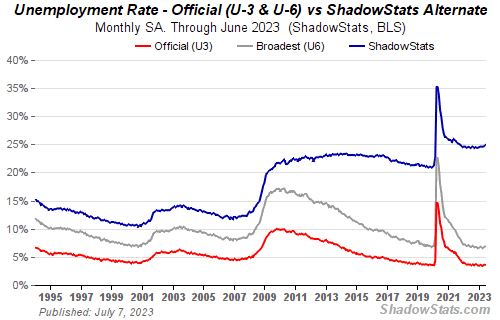
Notice how the reported stats have shrunk even as we're losing more jobs? Better information:

Chart of U.S. Unemployment


Banks failing at an alarming clip....

u.s. backing honduran coup, updated

[click image]

---------------------------------------------------------------

Welcome RAW STORY visitors. Sorry, if Dragg, my unfriendly cyber-stalker has inconvenienced you. The gig here is that you click the image for the piece I'm referencing, usually. That's not always immediately apparent to some. If you'd like to see what else I have on the Honduran coup, here you go. Thanks for stopping by.

---------------------------------------------------------------

I'd like to remind you that Uribe -- who got his constitution changed just as Zelaya was attempting to do -- was meeting with the president as he was refusing to meet with Zelaya or any of the other Latin American presidents asking for meetings. I'd like to remind you that while the OAS and UN have made tough resolutions against this coup and withdrawn ambassadors and sanctions start on Saturday if Zelaya is not restored, we have only broken off joint military operations and our ambassador is hosting Mrs. Zelaya. We're "concerned" and we don't recognize the new government, but are not about to be harsh about it or anything.

And Jeremy Scahill would like to remind you why President Zelaya's actions were legal....

Al Jazeera's latest....

---------------------------------------------------------------

State Department press conference call, making it clear as mud... sounding as though it supports Zelaya, but never saying that, just stuff about constitutional government for Honduras....
[State Department Official] We think that President Zelaya’s decision to postpone his earlier decision to return to Honduras on Thursday was a wise one. It’s important that the OAS be given an opportunity to engage in its diplomatic initiative to try to create a space so that President Zelaya’s return brings with it a peaceful restoration of democratic and constitutional order.
Honestly, Hillary or Joe could just get on a plane with Zelaya and deposit him back where he belongs, and that would be an end to it. If they're calling it a coup, and the OAS and UN are behind Zelaya's reinstatement, there just is NO impediment to doing the right thing.

israeli scumbags

[click image]
[Micheletti] expressed concern over the withdrawal of ambassadors from many nations, including all members of the European Union, but noted that Israel and Taiwan have already recognized his government and that 'international backing will grow.'

bubba probably kept it in his pants

[click image]

But ends up revealing, again, that he's breaking the laws for nonprofit foundations....

entrenched fascism, death of the constitution

[click image][click image]

You should listen to the stultifyingly calm interview at the end of this post, and you should read the piece they talk about near the end of that interview.

oh, just go make another blockbuster and shut up

[click image]

must be in the 'optional' column on the presidential job description

[click image]

I still try to find ways Obummer is doing well. This was one of them. Of course, California labs have the jump on the rest of the country because the Governator made sure to protect that.

01 July 2009

it is SO time for you to watch this again

[click image, video, hour and a half]

A friend emailed me the image link, but you can also watch it on Google Video if that's better for you.

I decided to bring this up because there are a whole lot of people in Tehran and in Honduras and across the world who really, really, really need to get a handle on just how perfidious American fascists are, just how outrageous it gets, just how easy it is for them to deceive their own population and the world.

I don't know how many times you have to be told, but, dammit, one of these times it's going to sink in.

The people who were in charge in Panama are still in charge now. They haven't stopped their filthy, criminal activities anywhere they deign to turn. Their capabilities are only limited by the number of people they can buy or scare into doing their will.

They will not stop until they are stopped.

[P.S. We are moving troops to the border.]

big pharma gonna kill yo ass

[click image]

They're just now getting around to doing something about a problem that has been abundantly evident to everyone for at least five years. The church lady who used to cut my hair said she flipped out when she realized she was looking at the inside of her face after taking just one. My high school buddy's wife started trying to have sex with passers-by and other outrageously self-destructive behaviors. My old boss couldn't get a sex life back for almost a year. My ex ate a bottle of valium -- unaware that would only give him a nice long nap -- in the woods. And that's just the people close to me.

Wake up.

crikey

[click image]

From a speech given by the CEO of News Corporation:
Then there are the bloggers.

In return for their free content, we pretty much get what we’ve paid for - something of such limited intellectual value as to be barely discernible from massive ignorance.

Andrew Keen in his book The Cult of the Amateur cites Hurricane Katrina as an example when: “reports from people at the scene helped spread unfounded rumours, inflated body counts and erroneous reports of rapes and gang violence in the New Orleans Superdome – all later debunked by mainstream news media”.

Citizen journalists, he says, simply don’t have the resources to bring us reliable news. They lack not only expertise and training but access to decision makers and reliable sources.

The difference, he says, between professionals and amateurs is that bloggers don’t go to jail for their work – they simply aren’t held accountable like real reporters.

Like Keating’s famous “all tip and no iceberg”, it could be said that the blogosphere is all eyeballs and no insight.

As Robert Thomsen of The Wall Street Journal says: “the blogs and comment sites are basically editorial echo chambers rather than centres of creation”.

“and their cynicism about so-called traditional media is only matched by their opportunism in exploiting it”

One of the best known comment sites in Australia matches this identikit.

It started as a moralising soapbox; boasting about its lack of standards. Positioned as an underdog, it lectures mainstream media every day.

In the blogosphere, of course, the mainstream media is always found wanting.

It really is time this myth was blown apart.

Blogs and a large number of comment sites specialise in political extremism and personal vilification.

Radical sweeping statements unsubstantiated with evidence are common.

One Australian blogger who shoots first and checks facts later is proud to boast that his site is “Not wrong for long”.

Mainstream media understands, most of the time, that comment and opinion is legitimised by evidence.

Opinions, however strongly held, draw their legitimacy from the factual accuracy that underpins them.

Many of these sites and bloggers say their radical new approach is a modern form of participatory democracy.

But as Andrew Keen says, amateur journalism trivialises and corrupts serious debate – it degenerates democracy into mob rule and rumour milling.

Most online news and comment sites don’t generate enough revenue to pay for good journalism.

Good journalism is expensive.

[Groupthink] recently announced it will spend 1.75 million US dollars on a new investigative journalism unit to produce original content.

But it is not being funded by subscribers or advertisers, it’s being bankrolled by philanthropy.

Earlier this year an argument was mounted for public funding of quality journalism. The argument is that as traditional media revenues dry up, there won’t be enough money to support the kind of important journalism our society needs.

Our job is to tell many people what few people know. That takes lots of resources – newsrooms of two and three hundred people. If we can’t afford them, important stories won’t get told.

It might mean that those in power and those with influence can avoid the scrutiny and accountability that keeps them in check.

...

The future of journalism won’t depend on bloggers, comment sites, Google or Yahoo.

It will depend on how well newspapers like the three I’ve just mentioned adapt to the digital age.

Absolutely central to this will be:

the skills and integrity of the journalists

their passion and curiosity

their capacity to understand their readers

and their willingness to serve them.

Which brings me finally to the future of journalism being the journalism itself

Demand for news – in print and online – is much larger than it was for print on its own.

In the past year, the Beijing Olympics, the Obama’s election, the GFC, the bushfires, the British expenses scandal and Michael Jackson’s death have all shown how large the audience can be for big stories with huge consequences.

I believe the appetite for quality news and information will grow dramatically.

People will pay for it if it is good enough.

By good enough I mean that it will have to be:

well researched

brilliantly written

perceptive and intelligent

professionally edited

accurate and reliable.

This is not the territory in which aggregator sites or amateur bloggers will do well.

This is the natural terrain of the well trained, professional, experienced, clever journalist.
Oh, yeah, you capitalist hog? Would that you crackheads could produce well researched, brilliantly written, perceptive and intelligent, professionally edited, accurate and reliable journalism! Maybe then people of good will wouldn't have to beat their brains to a zapping pulp day in and day out for no money to find anything remotely resembling actuality to share with their fellows, you posturing fuck.