Showing posts with label reminder. Show all posts

31 March 2011

reminder

[click image]

.

I have resisted mentioning this [not] news flash for at least twenty-four hours.
Pro-Gaddafi Forces
We're not killing ordinary people.
We're killing one evil dictator who happens to be
cleverly disguised as thousands of ordinary people.
How much more "transparent" do you think they can get while still not mentioning that Constitution and Morals are compost, right along with our brains?

.
love, 99
.

19 March 2011

wonder if it will clear up enough

[click image]

.

For me to get in my go-cart from the eighth dimension to find a place to watch the fullest possible moonrise tonight....

I could maybe carry out my threat to make my cd and learn how to make it play in my go-cart before it's too late to accomplish such a feat...?

.

Naw. I just checked and there's no hope.

I hope wherever you are you are out there gaping at this moon tonight. Kiss it for me.

.
love, 99
.

12 March 2011

even if he doesn't grok what i'm saying about the whirlpool

[click image]

.

Old Uncle Dave is still handy for reminding me of things like where to look for my car keys and when to agonize over my multifarious timekeeping mechanisms. I will have to break out the owner's tome for my go cart from the eighth dimension again, and I don't think I'll even bother with the high tech thermostat for my low tech heater. I can totally handle my analog wall clock. I think maybe I need to track down Joely about training my computer to bark instructions to me betimes because I seem to be much more bumbling than ever before lately. I hope it's just my sensitivity to all this tectonic action and/or my infected tooth, but I deeply suspect my chi is exiting through a black hole in my inner space. It's had it with this planet.

So. Spring forward all ye faithful.

.
love, 99
.

reminder

[click image]

.

Don't be distracted.
The price of a barrel of oil is sitting right [around $100] at this moment. How much do you think a “barrel” full of heroin sells for?

For relatively pure heroin, cultivated and shipped from Afghanistan, the world’s largest supplier of heroin — it would net you $19,923,200 USD PER BARREL.

Now, by the time that hits American and Russian streets … and is cut up and diluted several times, you are looking at roughly $60,000,000 – $80,000,000 US dollars per barrel of heroin.
And, just as an aside, just to make your blood boil, dig this....

.

Don't you love how I start this out telling you not to be distracted and then am too distracted to finish updating the cited post and link you to the latest? I'm sorry. I'm sorry. I will endeavor to remember that I'm a damn airhead before I hit "PUBLISH POST"... but remembering seems to be the problem lately....

Anyway, all fixed now, hours later, and maybe you didn't already try to read this....

.
love, 99
.

24 February 2011

pretty good stuff, maynard

[click image]
.

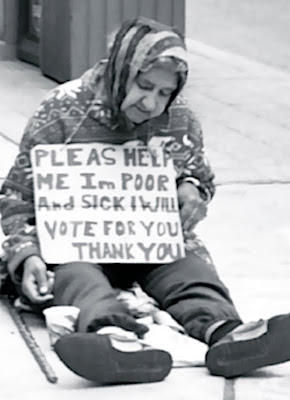
Eyes off that watch swinging on its fob....

.
love, 99
.

05 January 2011

reminder

[click image]

.

A friendly reminder of the cost of spectator sports.

.
love, 99
.

05 December 2010

reminder

[click image]

.

I love Coleen Rowley.

I linked this at the time, but it bears repeating, and bless Max for reminding me to remind you.
WikiLeaks and 9/11: What if?
Frustrated investigators might have chosen to leak information that their superiors bottled up, perhaps averting the terrorism attacks.
By Coleen Rowley and Bogdan Dzakovic
October 15, 2010

If WikiLeaks had been around in 2001, could the events of 9/11 have been prevented? The idea is worth considering.

The organization has drawn both high praise and searing criticism for its mission of publishing leaked documents without revealing their source, but we suspect the world hasn't yet fully seen its potential. Let us explain.

There were a lot of us in the run-up to Sept. 11 who had seen warning signs that something devastating might be in the planning stages. But we worked for ossified bureaucracies incapable of acting quickly and decisively. Lately, the two of us have been wondering how things might have been different if there had been a quick, confidential way to get information out.

One of us, Coleen Rowley, was a special agent/legal counsel at the FBI's Minneapolis division and worked closely with those who arrested would-be terrorist Zacarias Moussaoui on an immigration violation less than a month before the World Trade Center was destroyed.

Following up on a tip from flight school instructors who had become suspicious of the French Moroccan who claimed to want to fly a jet as an "ego boost," Special Agent Harry Samit and an INS colleague had detained Moussaoui. A foreign intelligence service promptly reported that he had connections with a foreign terrorist group, but FBI officials in Washington inexplicably turned down Samit's request for authority to search Moussaoui's laptop computer and personal effects.

Those same officials stonewalled Samit's supervisor, who pleaded with them in late August 2001 that he was "trying to keep someone from taking a plane and crashing into the World Trade Center." (Yes, he was that explicit.) Later, testifying at Moussaoui's trial, Samit testified that he believed the behavior of his FBI superiors in Washington constituted "criminal negligence."

The 9/11 Commission ultimately concluded that Moussaoui was most likely being primed as a Sept. 11 replacement pilot and that the hijackers probably would have postponed their strike if information about his arrest had been announced.

WikiLeaks might have provided a pressure valve for those agents who were terribly worried about what might happen and frustrated by their superiors' seeming indifference. They were indeed stuck in a perplexing, no-win ethical dilemma as time ticked away. Their bosses issued continual warnings against "talking to the media" and frowned on whistle-blowing, yet the agents felt a strong need to protect the public.

The other one of us writing this piece, Federal Air Marshal Bogdan Dzakovic, once co-led the Federal Aviation Administration's Red Team to probe for vulnerabilities in airport security. He also has a story of how warnings were ignored in the run-up to Sept. 11. In repeated tests of security, his team found weaknesses nine out of 10 times that would make it possible for hijackers to smuggle weapons aboard and seize control of airplanes. But the team's reports were ignored and suppressed, and the team was shut down entirely after 9/11.

In testimony to the 9/11 Commission, Dzakovic summed up his experience this way: "The Red Team was extraordinarily successful in killing large numbers of innocent people in the simulated attacks …[and yet] we were ordered not to write up our reports and not to retest airports where we found particularly egregious vulnerabilities.... Finally, the FAA started providing advance notification of when we would be conducting our 'undercover' tests and what we would be checking."

The commission included none of Dzakovic's testimony in its report.

Looking back, Dzakovic believes that if WikiLeaks had existed at the time, he would have gone to it as a last resort to highlight what he knew were serious vulnerabilities that were being ignored.

The 9/11 Commission concluded, correctly in our opinion, that the failure to share information within and between government agencies — and with the media and the public — led to an overall failure to "connect the dots."

Many government careerists are risk-averse. They avoid making waves and, when calamity strikes, are more concerned with protecting themselves than with figuring out what went wrong and correcting it.

Decisions to speak out inside or outside one's chain of command — let alone to be seen as a whistle-blower or leaker of information — is fraught with ethical and legal questions and can never be undertaken lightly. But there are times when it must be considered. Official channels for whistle-blower protections have long proved illusory. In the past, some government employees have gone to the media, but that can't be done fully anonymously, and it also puts reporters at risk of being sent to jail for refusing to reveal their sources. For all of these reasons, WikiLeaks provides a crucial safety valve.

Coleen Rowley, a FBI special agent for more than 20 years, was legal counsel to the FBI field office in Minneapolis from 1990 to 2003. Bogdan Dzakovic was a special agent for the FAA's security division. He filed a formal whistle-blower disclosure against the FAA for ignoring the vulnerabilities documented by the Red Team. For the past nine years he has been relegated to entry-level staff work for the Transportation Security Administration.
Coleen Rowley is my kind of countryman.

.
love, 99
.

24 November 2010

reminder

[click image]

.

Public service announcement....

.
love, 99
.

22 November 2010

reminder

[click image]

.

John's on PBS tonight.

.
love, 99
.

20 November 2010

northcom

[click image]

.

Just in case you wanted to keep track.

.
love, 99
.